What Is Membrane Roofing?
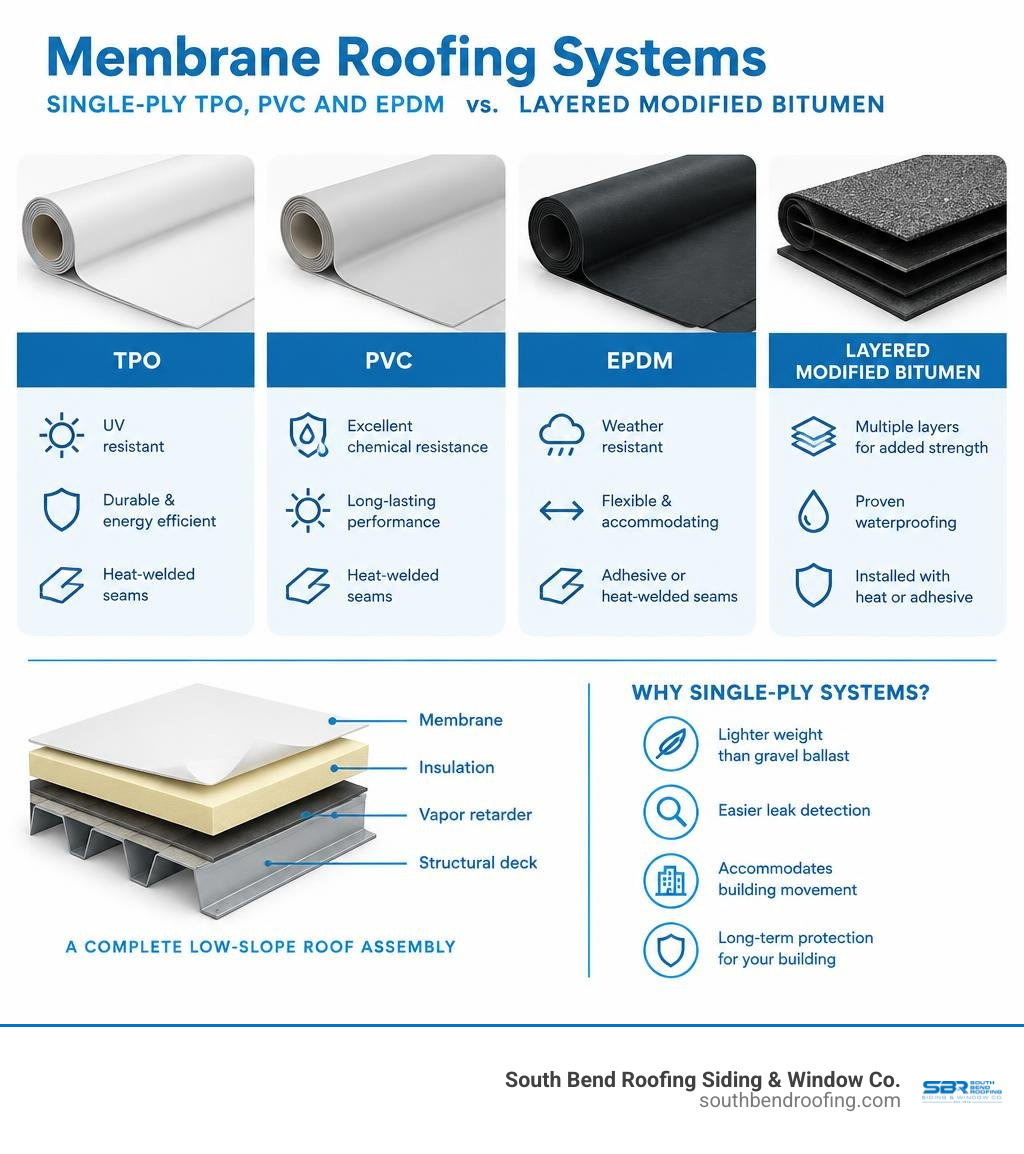
Membrane roofing is a watertight covering for flat and low-slope roofs. It protects commercial buildings and low-slope sections of homes where water cannot shed as quickly as it does from a steep roof. Common options include single-ply sheets made from TPO, PVC, or EPDM, as well as layered modified bitumen systems. The right choice depends on the roof's use, exposure to weather, and how its seams will be installed and maintained.
I'm James Spillman, Vice President at South Bend Roofing Siding & Window Co. I draw on our roofing work in Indiana and Michigan, including membrane roofing for commercial buildings, to help explain what matters when choosing a system.
Understanding Membrane Roofing Systems and Materials
Low-slope roofing requires an engineered barrier capable of handling standing water and slow runoff. According to building codes and standards outlined in The NRCA Roofing Manual: Membrane Roof Systems, a low-slope roof has a slope of 3:12 or less, with the International Building Code (IBC) requiring a minimum design slope of 1/4:12 to ensure positive drainage. Because water drains slowly at these pitches, traditional overlapping shingles cannot keep moisture out. Membrane systems solve this by forming continuous, monolithic waterproof seals over the roof deck.
Modern low-slope assemblies combine several components: structural roof decks, vapor retarders, rigid cover boards, and synthetic membrane sheets. Property owners exploring commercial roofing services often find that single-ply systems offer significant advantages over older asphalt assemblies. Single-ply membranes eliminate the excessive weight of gravel ballast, allow for easier leak detection, and accommodate building movement without fracturing.
Thermoset vs. Thermoplastic Membrane Roofing
Single-ply membranes fall into two chemical categories: thermoset elastomers and thermoplastic plastomers. The distinction between them determines how the sheets are joined and how they perform over decades of seasonal temperature shifts.
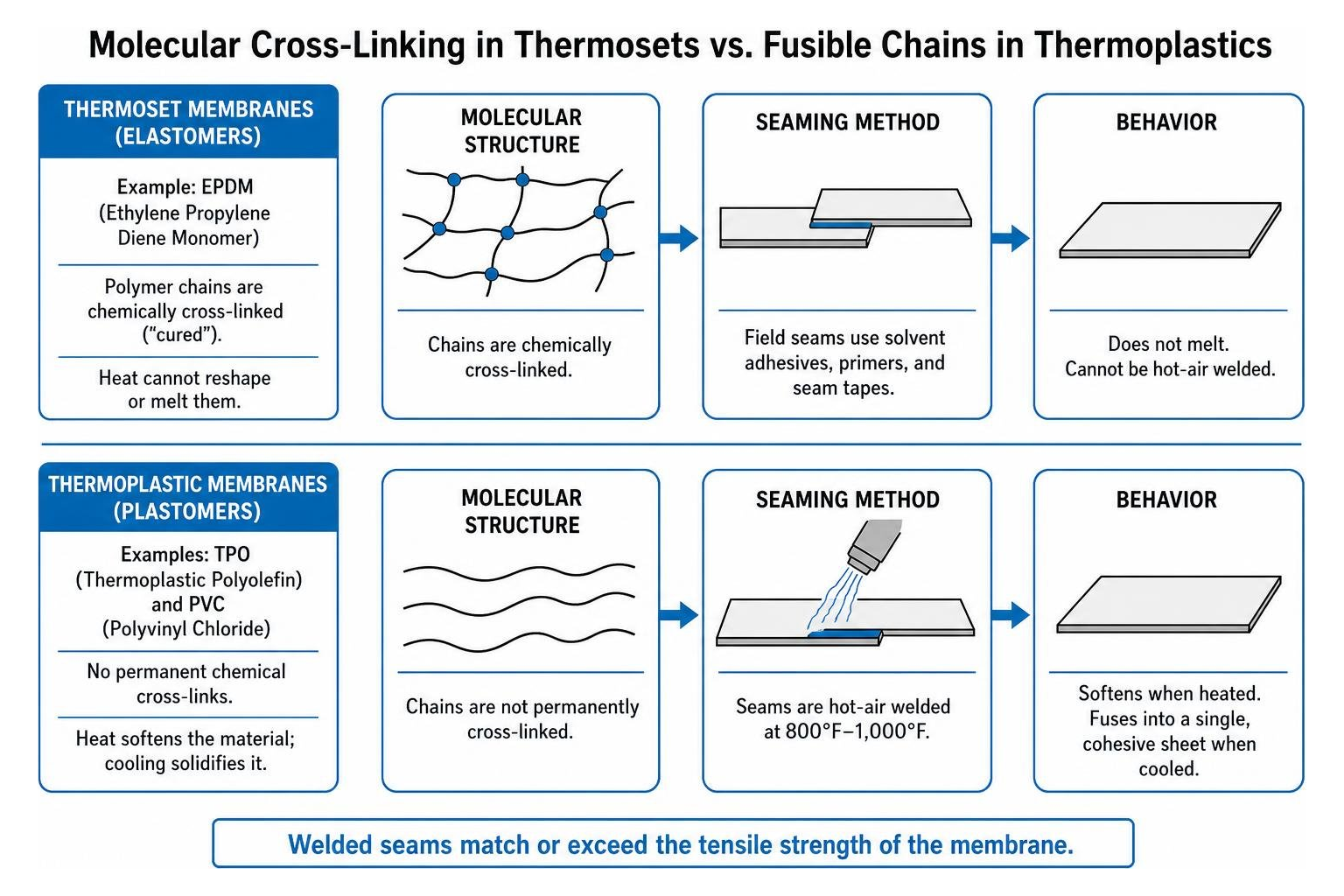
- Thermoset Membranes (Elastomers): EPDM (Ethylene Propylene Diene Monomer) synthetic rubber is the most common thermoset material. During manufacturing, the polymer chains are chemically cross-linked ("cured"). Once set, heat cannot reshape or melt them. Because thermosets do not melt, field seams cannot be welded. Instead, installers connect overlapping sheets using specially formulated solvent adhesives, primers, and seam tapes.
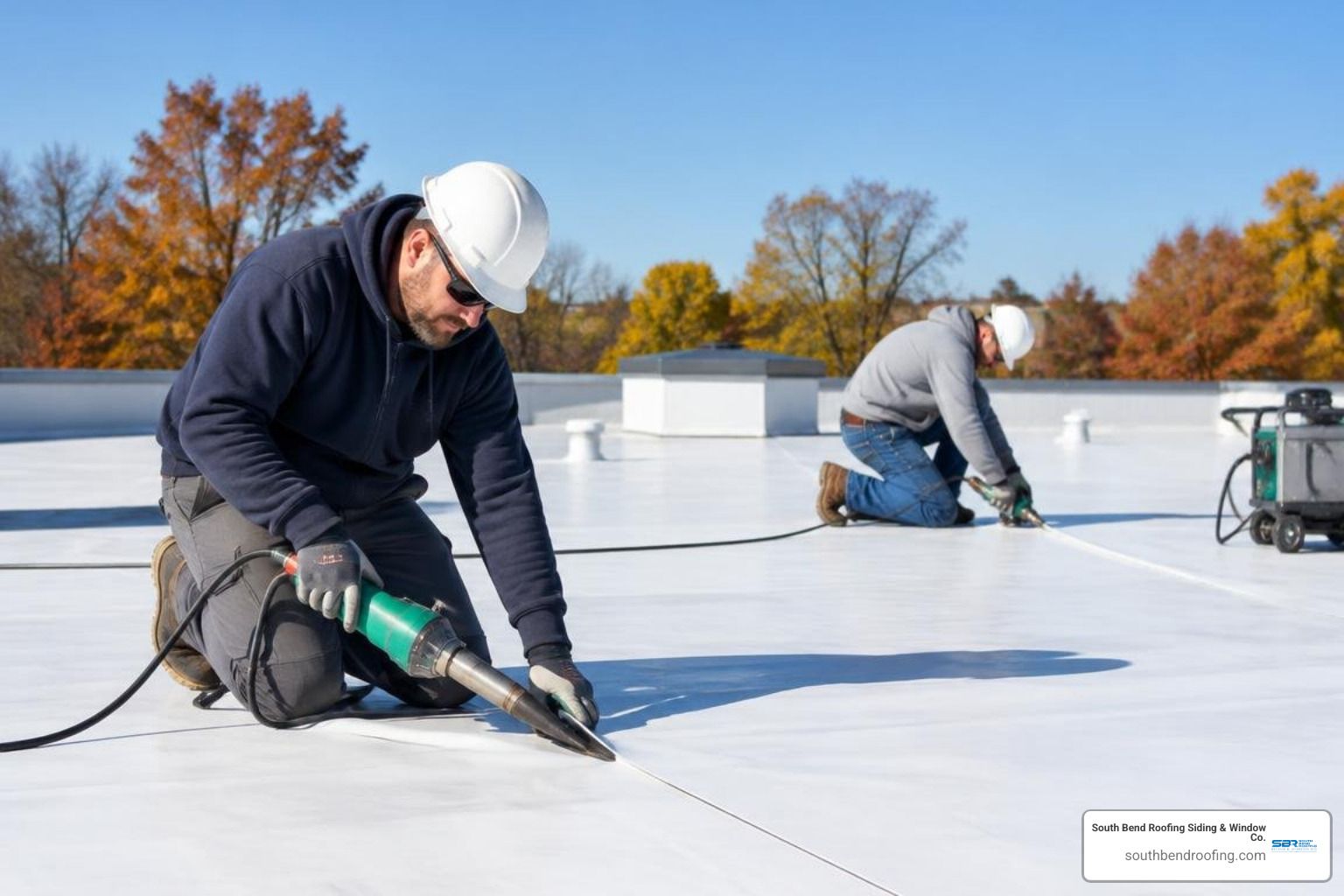
- Thermoplastic Membranes (Plastomers): Materials such as TPO (Thermoplastic Polyolefin) and PVC (Polyvinyl Chloride) do not form permanent chemical cross-links. When heated, the material softens, and when cooled, it solidifies. This allows seams to be hot-air welded at temperatures between 800°F and 1,000°F. The two overlapping sheets fuse into a single, cohesive sheet. The welded seam matches or exceeds the tensile strength of the membrane itself.
Material science confirms that the seam is the most critical point of any low-slope roof. As documented in a National Research Council Canada low-slope membrane study, the internal reinforcing scrim does not bridge across lap joints. The long-term strength of the joint depends entirely on the bonding method. While hot-air welded seams remain molecularly bonded, adhesive seams on rubber roofs require ongoing inspection to prevent stress separation as the material ages. For projects where rubber is the right fit, working with certified rubber roofing contractors ensures that primers, seam tapes, and lap sealants are applied correctly.
Single-Ply Options: TPO, PVC, PVC KEE, and EPDM
Choosing the right single-ply membrane depends on building use, rooftop chemical exposure, and budget.
| Membrane Type | Polymer Category | Seam Technology | Chemical & Grease Resistance | UV Reflectivity & Energy Efficiency | Primary Applications |
|---|---|---|---|---|---|
| TPO | Thermoplastic | Hot-Air Welded | Moderate | High (Bright white standard) | Warehouses, big-box retail, office buildings |
| PVC | Thermoplastic | Hot-Air Welded | High (Resists animal fats and oils) | High (Standard reflective white/gray) | Restaurants, food processing, flat residential roofs |
| PVC KEE | Thermoplastic | Hot-Air Welded | Superior (Resists jet fuels and harsh chemicals) | High (Long-term plasticizer retention) | Airports, industrial chemical plants, premium commercial roofs |
| EPDM | Thermoset | Taped / Contact Adhesive | Low to Moderate | Low (Standard black; white available) | Large footprint distribution centers, cold climates |
- TPO (Thermoplastic Polyolefin): TPO accounts for over 50% of the commercial market. It blends polypropylene and ethylene-propylene rubber with an internal reinforcing fabric scrim. It provides excellent tear and puncture resistance, along with high solar reflectivity, at an accessible cost.
- PVC (Polyvinyl Chloride): PVC is inherently fire-resistant and self-extinguishing. It offers superior resistance to animal fats, restaurant grease vents, and rooftop acids that can deteriorate other materials. For detail-heavy installations, our team often relies on advanced Duro-Last PVC systems, which feature custom-prefabricated membrane sheets that eliminate up to 85% of rooftop field seams. You can learn more about these steps in our PVC roofing installation guide.
- PVC KEE (Ketone Ethylene Ester): Standard PVC uses liquid plasticizers for flexibility, which can slowly migrate out over time. PVC KEE incorporates a solid, high-molecular-weight polymer plasticizer that stays locked in the sheet. This provides lasting flexibility and protects against aviation fuel, industrial exhausts, and severe UV radiation.
- EPDM (Synthetic Rubber): EPDM makes up roughly 15% of the commercial market. It offers unmatched elasticity, expanding and contracting easily during extreme freeze-thaw cycles. EPDM performs reliably in northern climates, though its glued seams require regular checkups to verify lap-joint integrity.
Membrane Attachment Methods and Structural Assemblies
A roofing membrane must stay securely attached to the building under severe wind uplift pressures. System performance relies on following verified installation standards, such as the IBHS single-ply membrane guidance, which outlines securement guidelines to protect structures from storm damage.
Mechanically Fastened, Fully Adhered, and Ballasted Attachment
Proper membrane roofing installation uses one of three primary attachment methods:
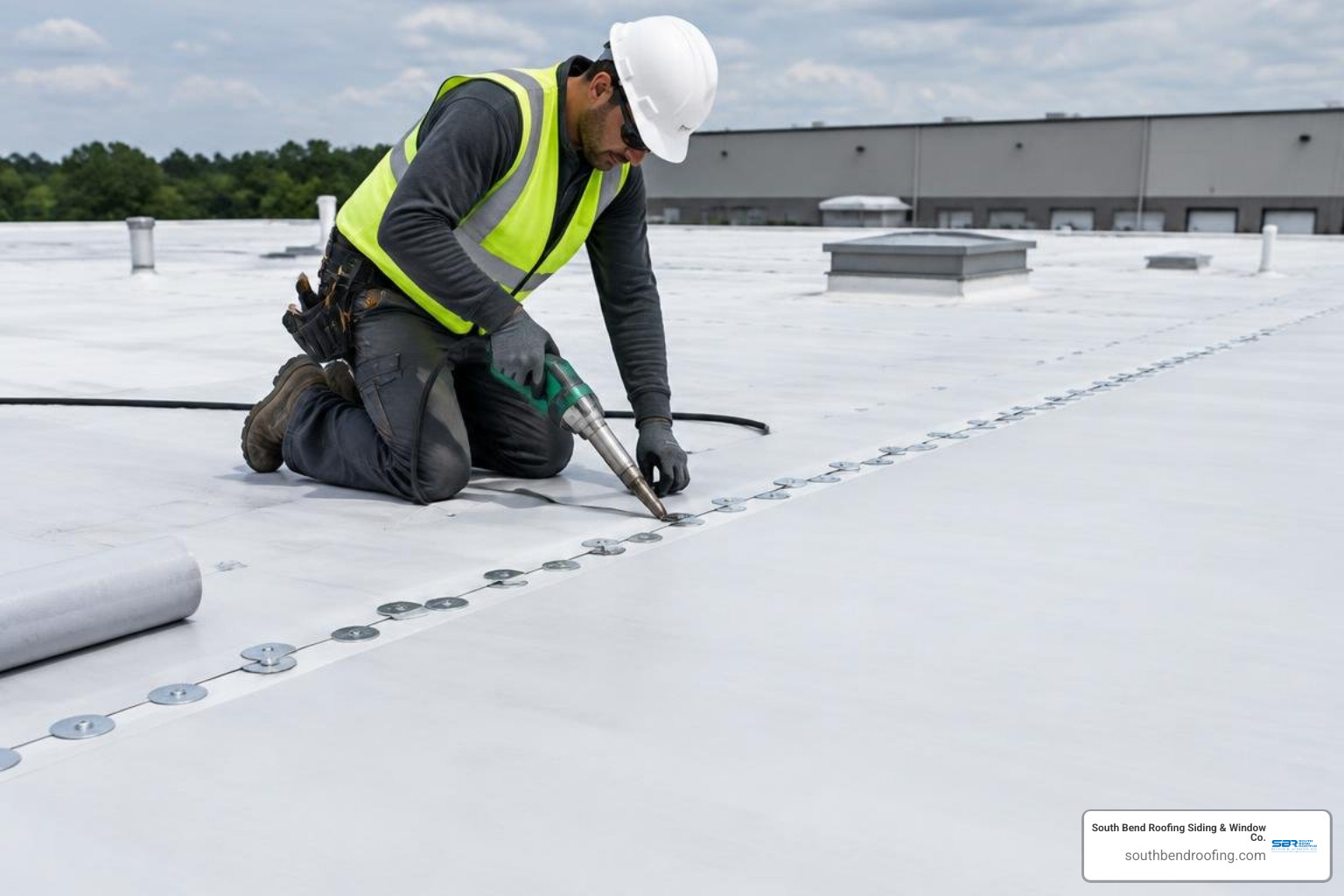
- Mechanically Fastened: Heavy-duty steel screws and barbed stress plates anchor the membrane through the cover board directly into the roof deck (typically 22-gauge steel or wood). Fasteners are placed along the edge of the sheet, and the overlapping sheet is hot-air welded over them. This creates a concealed anchor point without puncturing the weatherproofing layer. This method installs quickly and works well across large commercial spaces.
- Fully Adhered: The membrane is bonded directly to the substrate using water-based, solvent-based, or low-VOC contact adhesives. Fully adhered assemblies provide smooth surfaces, minimize wind fluttering, and resist wind uplift exceptionally well. They are ideal for high-wind areas, concrete decks, and buildings with high internal humidity.
- Ballasted: Large membrane sheets are laid loose over the cover board and held down with washed river rock or concrete pavers (typically 10 to 12 pounds per square foot). While ballasting saves on adhesive and fastener labor, it adds significant dead weight to the building framing, makes leak detection difficult, and carries a risk of gravel scouring in high winds.
Conventional Roof Assemblies vs. Protected Membrane Roofs (PMR)
Placement of the thermal layer plays a major role in the lifespan and maintenance of low-slope roofs, as detailed in Archtoolbox flat roof membrane specifications.
- Conventional Roof Assemblies: The thermal layer sits directly beneath the waterproofing membrane. This is the most common configuration. Placing the thermal layer under the membrane prevents solar heat from dissipating into the building, which increases the membrane's surface temperature. These high surface temperatures can accelerate thermal expansion, contraction, and surface oxidation, making UV-reflective cap layers essential.
- Protected Membrane Roofs (PMR / IRMA): In an Inverted Roof Membrane Assembly, the waterproofing membrane is applied directly to the structural deck, with moisture-resistant extruded polystyrene boards installed above it. A layer of filter fabric and stone ballast or concrete pavers holds the assembly in place. This shields the membrane from UV exposure, foot traffic, hail impacts, and daily thermal shocks. However, locating leaks requires moving heavy ballast and the upper layers to access the membrane below.
Performance, Durability, and Environmental Considerations
Low-slope roofs bear the brunt of solar radiation and severe weather. The Cool Roof Rating Council low-slope standards evaluate initial and aged Solar Reflectance Index (SRI) values to measure how effectively roofing materials reflect solar energy and emit absorbed heat. High-SRI white TPO and PVC membranes reduce building cooling demands and ease the urban heat island effect in developed commercial corridors. These cool-roof advantages also benefit low-slope sections of homes through dedicated residential roofing services.
Environmental and Health Impacts of Membrane Roofing
The chemical makeup and installation methods of membrane systems carry important health and environmental considerations:
- Occupational Safety: Traditional asphalt built-up roofing exposes workers to hot bitumen fumes, which the International Agency for Research on Cancer (IARC) classifies as probable carcinogens. Single-ply installations eliminate these fumes. Mechanically fastened systems also reduce installer exposure to the strong volatile organic compounds (VOCs) found in solvent-based adhesives.
- Building Air Quality: Solvents and chemical primers can enter HVAC air intakes during installation on occupied buildings. Using low-VOC water-based adhesives, pre-welded systems, or mechanically attached sheets prevents fumes from entering the living or working spaces below.
- Stormwater Runoff: Rainwater washing over roofs can pick up trace elements. Older formulations containing heavy liquid plasticizers, halogenated flame retardants, or untreated biocides can leach into local stormwater. Modern TPO and solid-polymer PVC KEE membranes use stable formulations that keep chemical migration into surrounding soils and municipal drains to a minimum.
Hail, Wind Uplift, and Severe Weather Performance
Midwest and Great Lakes weather brings severe wind gusts, heavy winter snow, and hail. Single-ply membranes handle these conditions based on reinforcement scrim construction and system engineering:
- Wind Uplift Engineering: Commercial assemblies are tested by agencies like FM Approvals and cataloged in the ROOFNAV database. Fastener density, plate sizing, and edge metal flashings are engineered to resist local basic wind speeds. Secure edge terminations prevent wind from getting under the membrane and peeling it back.
- Hail and Puncture Resistance: Hail resistance depends heavily on membrane thickness (measured in mils; 1 mil = 1/1,000 of an inch). Standard thicknesses range from 45 to 80 mils or more. Thicker membranes (60 to 80 mils) offer significantly higher puncture resistance against falling tree limbs, heavy tools, and wind-driven hail.
Membrane Roof Maintenance, Repair, and Replacement
Consistent preventive maintenance protects your roof investment and stops small issues before they become major leaks.

Routine Maintenance and Leak Detection Protocols
We recommend semi-annual roof inspections—once in spring after winter freeze-thaw cycles, and once in autumn before snowfall. A typical commercial maintenance inspection covers:
- Drainage Inspections: Clearing debris from roof drains, scuppers, and interior collection basins to prevent standing water from exceeding the 48-hour drainage window.
- Seam Probing: Using a blunt seam probe along welded or taped laps to check for edge lifting, fishmouth voids, or adhesive gaps.
- Flashing and Penetration Checks: Inspecting rooftop HVAC units, pipe boots, skylights, and parapet walls for cracked pitch pockets or loose termination bars.
- Surface Checks: Checking high-traffic maintenance paths for cuts, dropped tool punctures, or displaced walk pads.
When an active leak cannot be spotted visually, advanced diagnostic tools help pinpoint the source. Infrared thermography scans the roof at dusk to identify trapped moisture within the roof assembly, which retains heat longer than dry areas. For single-ply roofs, non-destructive electronic leak detection (vector mapping) pulses a low-voltage electrical current across the membrane surface to isolate breaches as small as a pinhole. We also provide documentation through an insurance roof inspection if your roof suffers storm damage.
Repair vs. Re-Cover vs. Complete Tear-Off
When problems appear, an honest assessment determines whether a quick repair, a retrofit recover, or a complete tear-off is the right move. If an issue is caught early, a targeted roof repair is often all that is needed to restore the watertight barrier and extend the roof's working life.
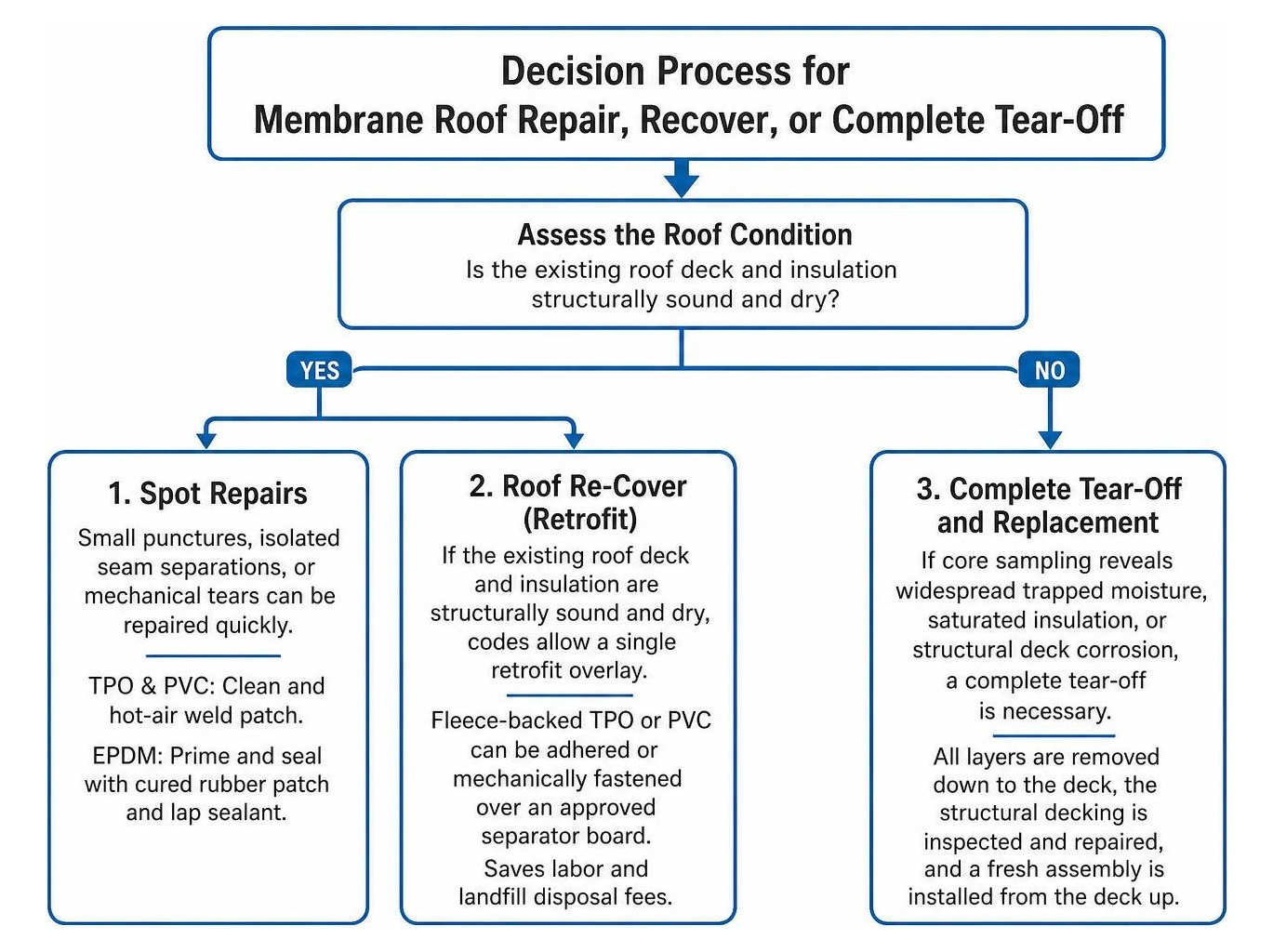
- Spot Repairs: Small punctures, isolated seam separations, or mechanical tears can be repaired quickly. On TPO and PVC systems, the surface is cleaned and a matching membrane patch is hot-air welded directly over the damaged area. On EPDM, the repair area is primed and sealed with cured rubber patches and lap sealant.
- Roof Re-Cover (Retrofit): If the existing roof deck and underlying layers are structurally sound and dry, building codes generally allow a single retrofit overlay without tearing off the old assembly. A fleece-backed TPO or PVC membrane can be adhered or mechanically fastened over an approved separator board. This saves substantial labor and landfill disposal fees.
- Complete Tear-Off and Replacement: If core sampling reveals widespread trapped moisture, saturated cover boards, or structural deck corrosion, a complete tear-off is necessary. All layers are removed down to the deck, the structural decking is inspected and repaired, and a fresh assembly is installed from the deck up.
Frequently Asked Questions About Membrane Roofing
What is the expected lifespan and warranty coverage for a membrane roof?
A membrane roof's lifespan depends on membrane thickness, material quality, exposure to weather, and regular maintenance. Thicker membranes (such as 60-mil or 80-mil options) consistently deliver greater durability and resistance to weathering. Warranty coverage varies by manufacturer and system specifications. Our team will review the available warranty terms and details with you during your project consultation.
How do heat-welded seams differ from glued or taped seams?
Thermoplastic membranes (PVC and TPO) fuse together under high-temperature hot air, blending the sheets into a continuous, molecularly bonded seam that resists peeling. Thermoset membranes (EPDM) cannot be melted without damaging the rubber. They rely on contact primers, adhesives, and double-sided butyl tapes to join overlapping sheets. While taped seams are effective, they require periodic inspections to ensure the adhesive bond remains sound over time.
Can a new membrane roof be installed over an existing flat roof?
Yes, provided local building codes permit a re-cover (most codes allow up to two roofing layers) and structural analysis confirms the deck can support the weight. Before moving forward, the roof must undergo a moisture survey or thermal scan to verify that the existing assembly is dry. If trapped water is present, the wet sections must be cut out and replaced before installing the new membrane.
Conclusion
Choosing the right membrane roofing system protects your property, lowers energy costs, and delivers dependable weather protection year after year. Whether you need a puncture-resistant PVC installation for a restaurant, a reflective TPO system for a commercial warehouse, or a durable EPDM system for a home addition, success comes down to proper material selection and careful seam execution.
Serving property owners across Indiana and Michigan since 1914, South Bend Roofing Siding & Window Co. brings over 110 years of trusted local roofing experience to every job. Our certified installers handle full replacements, re-covers, and routine maintenance tailored around your building's schedule to keep disruptions to a minimum.
To discuss your project or schedule a free roof inspection and written estimate, call our team today at (574) 288-4764.