How to Choose TPO Roofing Contractors Near Me
If you're searching for tpo roofing contractors near me, start with roofers who have experience installing flat and low-slope membranes. Ask how they heat-weld and inspect seams, then check their insurance, local references, and written scope of work. A nearby roofer is useful, but proven seam work matters more than distance alone.
TPO is a light-colored, single-ply roofing membrane that reflects sunlight. Its overlapping sheets are joined with hot air to form water-resistant seams. A sound seam can help prevent leaks; a poorly welded one can leave the roof vulnerable.
I'm James Spillman, vice president at South Bend Roofing Siding & Window Co., which has served local property owners since 1914. When people ask me how to compare tpo roofing contractors near me, I point them toward clear answers about seam quality, roof condition, and warranty coverage.
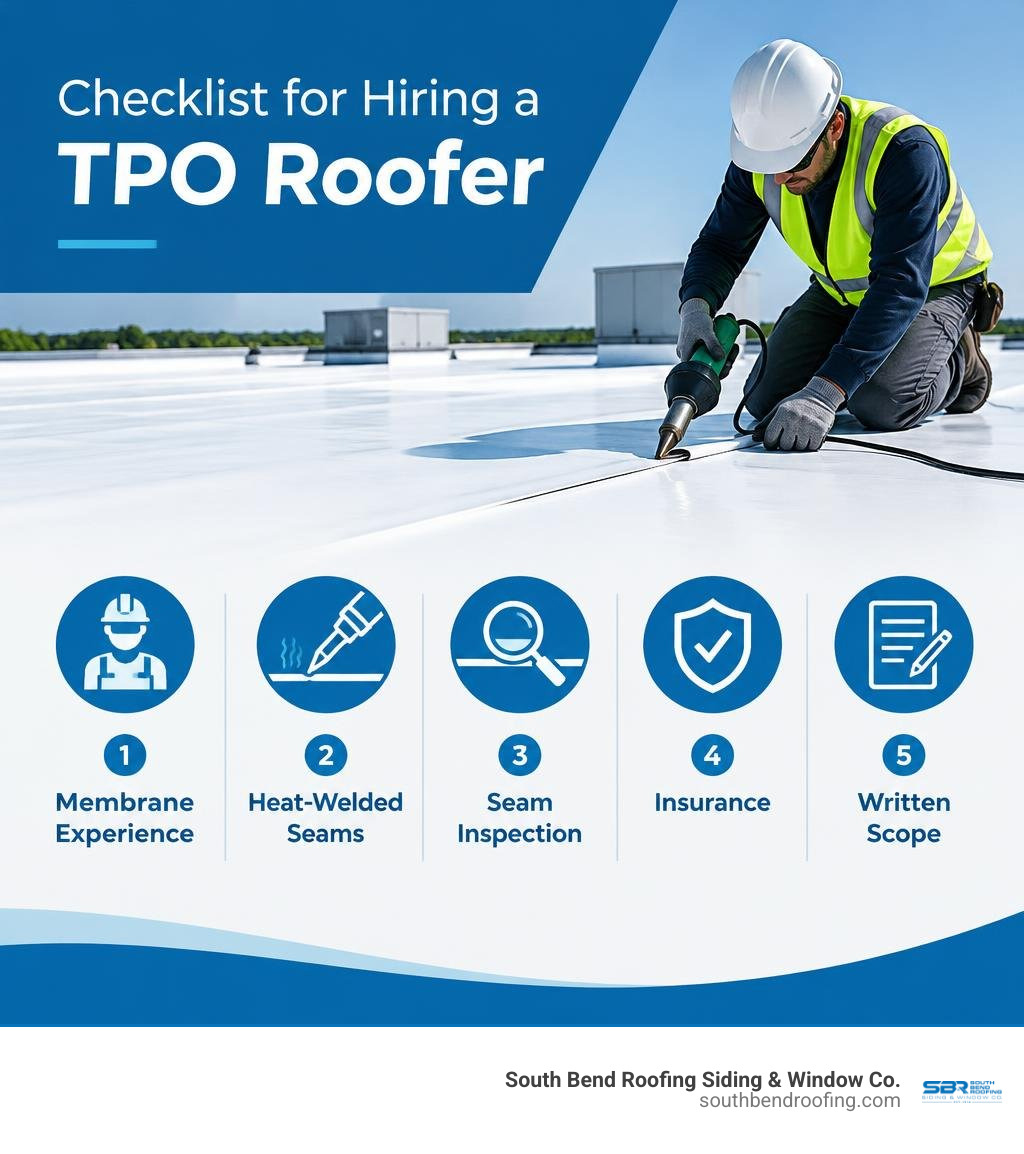
Why Heat-Welded Seams Define Single-Ply Roofing Longevity
Thermoplastic Polyolefin (TPO) single-ply membranes have become a leading choice for commercial and residential low-slope applications across Indiana and Michigan. Composed of a polymer base, high-strength polyester scrim reinforcement, and a UV-resistant top ply, TPO delivers remarkable solar reflectivity, puncture resistance, and energy efficiency. However, the true strength of any single-ply membrane installation lies directly in its seam integrity.
Unlike traditional asphalt or rubber systems that rely on liquid glues, tapes, or chemical adhesives, TPO relies on thermal fusion. When performed according to strict manufacturer standards, such as those outlined in the Firestone UltraPly™ TPO Roofing Systems Application Guide, heat-welded seams create a continuous, monolithic waterproof barrier that is physically stronger than the membrane itself.
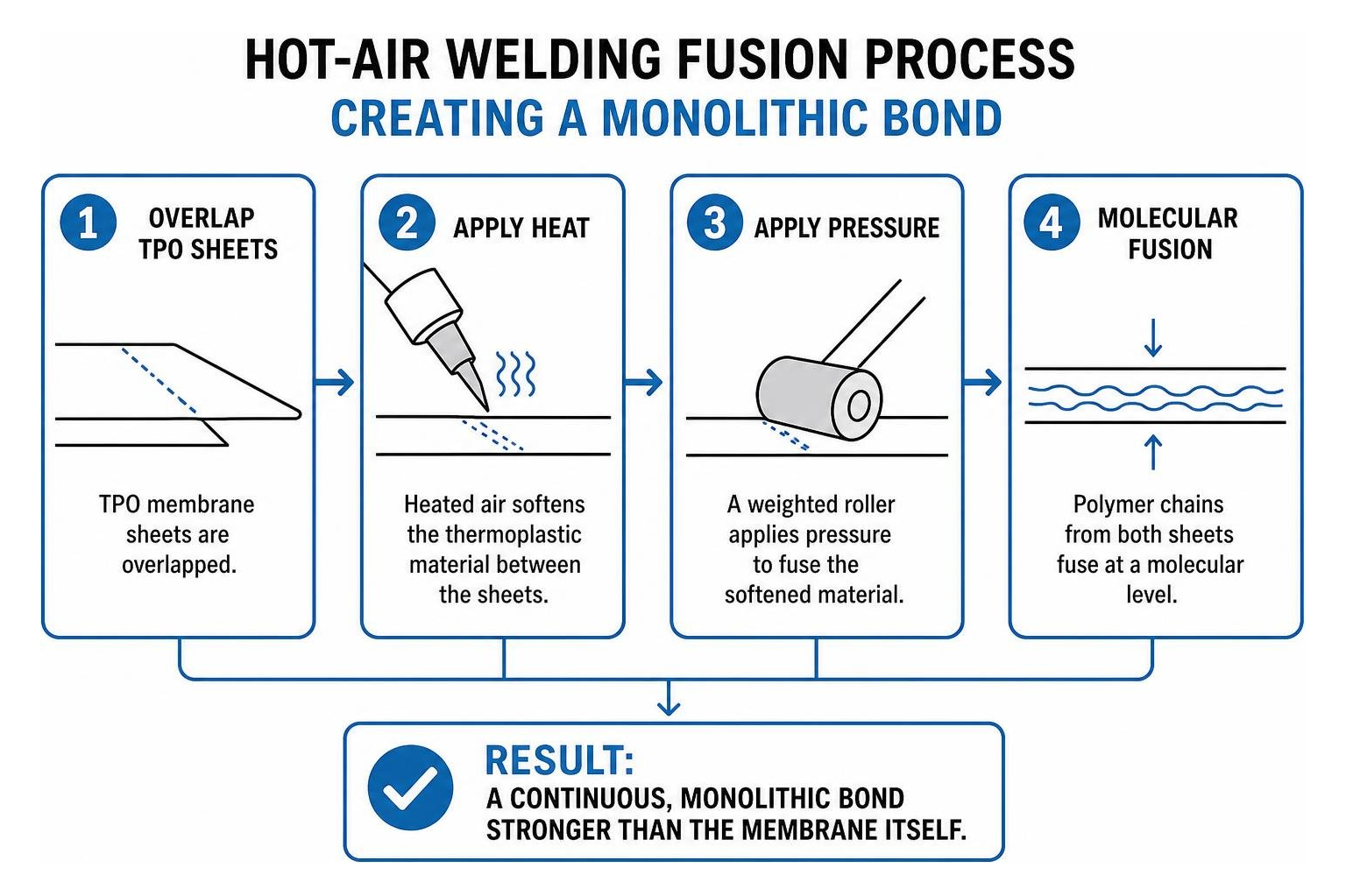
The Science of Thermoplastic Polyolefin Seam Fusion
Hot-air welding works by delivering precise, heated air between overlapping sheets of TPO membrane while simultaneously applying mechanical pressure with a weighted roller. As the thermoplastic material reaches its melting temperature, the polymer chains in the top and bottom sheets fuse together at a molecular level.
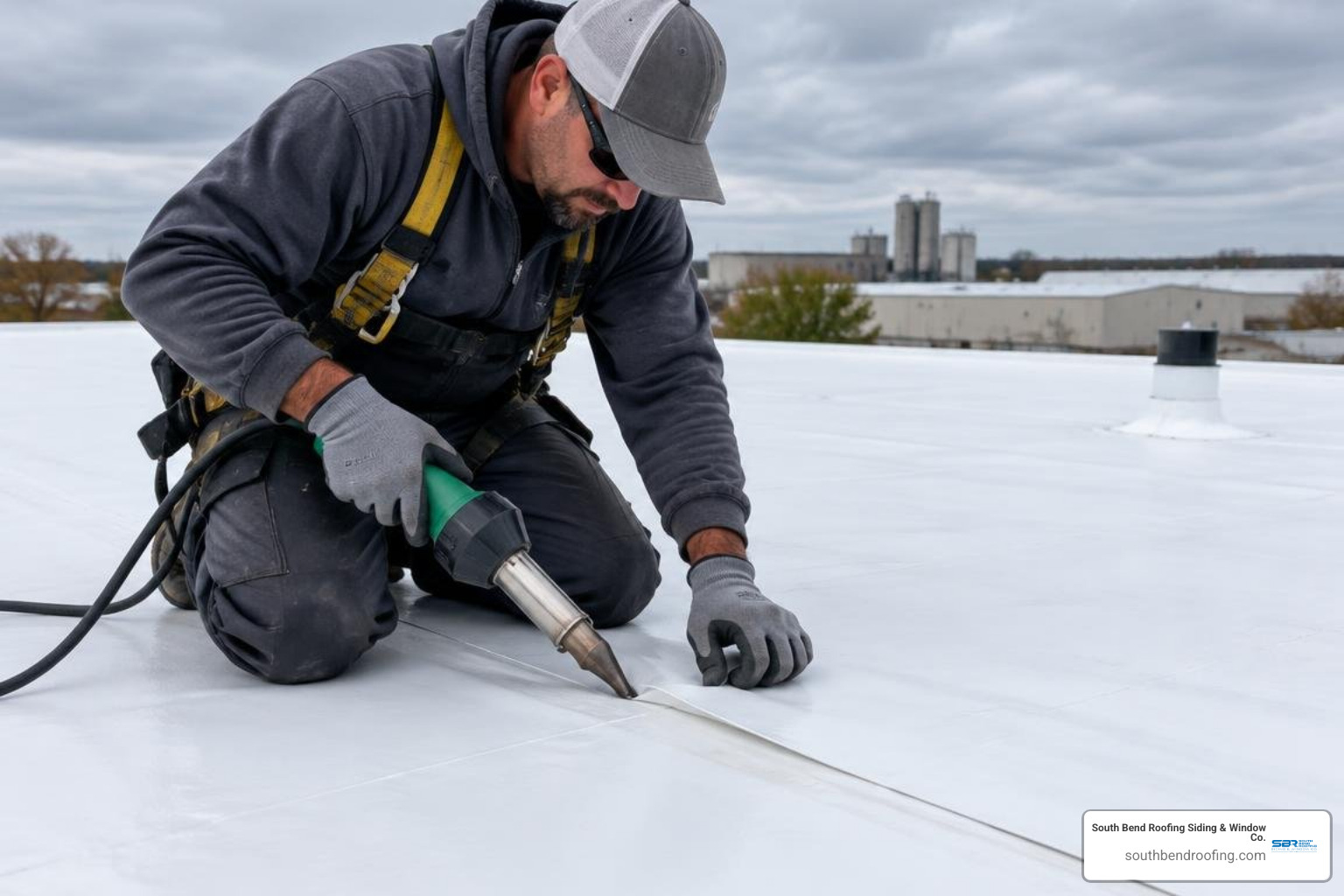
Professional roofing teams employ both automated robotic welders for long, open runs and handheld heat guns for detailed flashing around curbs, parapet walls, and pipes. The quality of this thermal fusion depends heavily on membrane thickness, which typically ranges from 45-mil to 80-mil. Thicker membranes provide a deeper welding layer, greater puncture resistance, and enhanced durability against environmental stressors.
To verify seam quality, certified technicians use two primary diagnostic methods:
- Physical Peel Tests: Conducted at the start of each workday and after major temperature shifts to calibrate hot-air equipment speed and heat settings. A successful test results in a "film-tearing bond," meaning the material tears outside the weld area because the fused seam is stronger than the parent sheet.
- Seam Probing: Once the weld cools, technicians run a blunt, rounded cotter pin or seam probe along every linear inch of the overlapping joint. If the tool catches or penetrates the edge, it reveals a void that requires immediate re-welding and patching.
Identifying High-Quality Seams vs. Faulty Weld Execution
Executing a perfect weld requires skill, patience, and meticulous deck preparation. Before any heat is applied, the rolled-out membrane must be given approximately 30 minutes of relaxation time. Skipping this step can cause the membrane to develop wrinkles, which create stress concentrations and compromise weld consistency.
When evaluating professional membrane roofing installation, look for these distinct markers of workmanship:
- Uniform Bleed-Out: A high-quality weld displays a consistent 1.5-inch to 2-inch weld width with a slight, continuous bead of melted polymer ("bleed-out") visible along the seam edge, indicating full material fusion without scorching.
- Absence of Cold Welds: Cold or "false" welds occur when the hot-air tool moves too quickly or at an insufficient temperature. The sheets may stick together temporarily, but they pull apart easily under wind uplift or foot traffic because molecular fusion never occurred.
- Smooth, Unblistered Surfaces: Overheating the material burns the polymer and degrades the internal polyester scrim, leading to surface discoloration, blistering, and premature seam failure.
- Proper Edge Metal Coping: Seams terminating at roof perimeters must be properly detailed and secured with heavy-gauge metal coping to prevent wind-driven rain from lifting the assembly.
How to Vet TPO Roofing Contractors Near Me for Flat Roof Projects
Selecting a qualified single-ply membrane contractor requires a different approach than hiring a residential shingle roofer. Flat and low-slope roofing systems demand precise thermal welding equipment, deep understanding of structural water drainage, and specialized knowledge of wind uplift dynamics.
Key Credentials to Demand from TPO Roofing Contractors Near Me
To protect your building investment, verify that any contractor you consider possesses the technical capabilities and business stability required for commercial-grade work:
- Dedicated Single-Ply Experience: Ensure the contractor has a proven history of installing single-ply systems. Ask for local references on buildings of similar scale and complexity.
- Licensing and Comprehensive Insurance: Demand certificates of general liability insurance and active workers' compensation coverage tailored specifically for commercial roofing operations.
- Manufacturer Certifications: Top-tier manufacturers certify select contractors who pass rigorous quality audits, granting them the authorization to install warrantied assemblies and extended system protections.
- In-House, Trained Crews: Inquire whether the actual installation and seam welding will be handled by trained, accountable employees or outsourced to temporary third parties unfamiliar with commercial hot-air welding equipment.
- Detailed Written Scopes: A professional proposal must outline every phase of the project, including tear-off procedures, substrate decking repairs, membrane mil thickness, attachment methods, flashing details, and cleanup protocols.
You can verify general business standing by evaluating contractor integrity through the BBB, which helps ensure you are working with experienced roofing contractors in my area who adhere to ethical standards.
Red Flags and Warning Signs to Avoid Before Hiring
Flat roofing repairs and installations can fail quickly if an inexperienced crew cuts corners. Watch out for these common warning signs during your vetting process:
- Door-to-Door Solicitations: Transient contractors who flood neighborhoods after severe hailstorms or high winds often lack permanent local roots and disappear before seam leaks manifest.
- Verbal-Only Quotes: Never accept vague, handshake agreements. Without an itemized written specification, you have no legal recourse if critical steps like deck inspection or proper edge flashing are skipped.
- Chemical Glue Shortcuts: If a contractor suggests using standard contact adhesives or unapproved tapes to join primary TPO field seams instead of hot-air welding, dismiss them immediately. TPO cannot maintain a dependable, long-term seam without heat fusion.
- Absence of a Physical Office: Reputable contractors maintain established facilities and warehousing capabilities to stage materials properly and respond promptly to service calls.
- Full Upfront Payment Demands: A trustworthy contractor operates with standard milestone payments tied to material delivery and verified installation progress rather than demanding total payment before work begins.
You can cross-reference qualifications using independent industry resources like the verified contractor directory at Find the Right Roofer.
Single-Ply Membrane Comparison: TPO vs. PVC vs. EPDM
Choosing the right membrane depends on your building's specific architectural layout, environmental exposures, rooftop equipment, and performance goals. While TPO, PVC, and EPDM represent the core of modern low-slope roofing, each material delivers distinct characteristics.
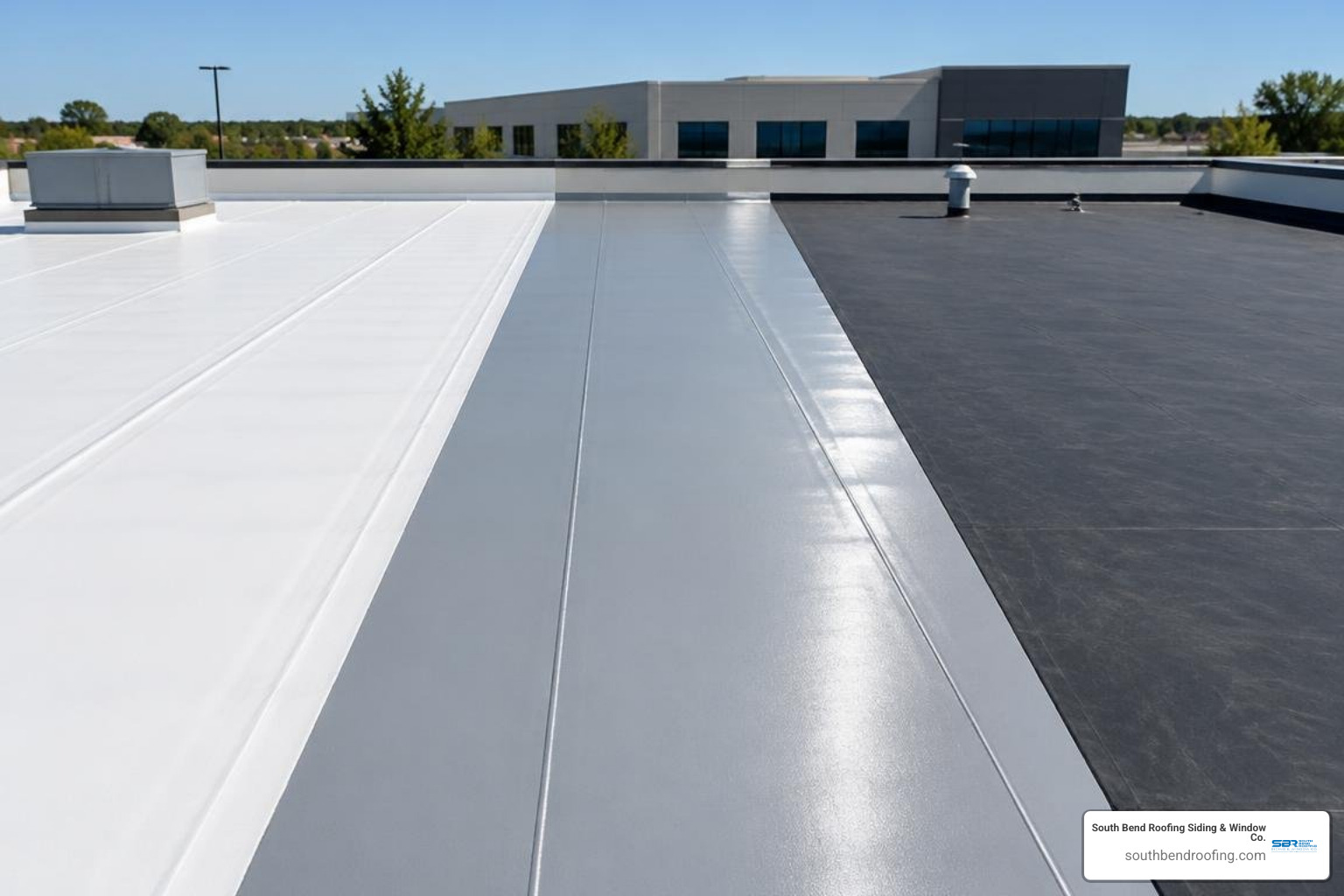
Performance Factor TPO (Thermoplastic Polyolefin) PVC (Polyvinyl Chloride) EPDM (Ethylene Propylene Diene Monomer) Primary Seam Method Hot-Air Heat Welded Hot-Air Heat Welded Tapes & Liquid Adhesives Solar Reflectance Excellent (High initial and aged reflectivity) Excellent (High reflectivity) Poor (Naturally dark, absorbs heat) Chemical & Grease Resistance Moderate (Good against acids and bases) Exceptional (Ideal for restaurants and industrial sites) Low to Moderate (Vulnerable to petroleum products) Material Flexibility High (Maintains pliability across broad temperature swings) High (Formulated with specialized plasticizers) Outstanding (Natural rubber elasticity) Relative Material Investment Cost-Effective Premium Moderate TPO and PVC share the immense advantage of hot-air welded seams, eliminating the maintenance vulnerabilities associated with adhesive degradation over time. PVC remains the benchmark for rooftops exposed to heavy grease, oils, or industrial chemicals, such as restaurant exhausts or manufacturing facilities.
Meanwhile, EPDM rubber provides proven elasticity in freeze-thaw cycles, but its taped seams require ongoing maintenance as adhesives dry out and age. TPO provides the optimal balance for most retail, commercial, and residential low-slope applications, combining heat-welded seam strength with high solar reflectance to lower cooling demand.
Our team provides tailored commercial roofing services to help building owners identify the exact single-ply formulation required for their specific roof geometry and operational demands.
TPO Installation Methods, Routine Maintenance, and Seam Repairs
A single-ply membrane's long-term performance relies on selecting the appropriate attachment method and supporting it with consistent, routine care.
Attachment Methods: Fully Adhered, Mechanically Attached, and Ballasted
The structure of your roof deck, local wind uplift requirements, and building height dictate how the TPO membrane is secured:
- Mechanically Attached Systems: The membrane is fastened to the underlying roof deck using specialized heavy-duty screws and barbed distribution plates placed within the overlapping seam margins. Once the fasteners are secured, the adjacent sheet is rolled over the plate line and hot-air welded. This method is fast, cost-effective, and highly reliable for steel and wood decks.
- Fully Adhered Systems: The membrane is bonded directly to approved substrate boards using specialized commercial adhesives. This method produces a smooth, aesthetically clean finish with superior wind uplift resistance and eliminates membrane flutter, making it ideal for high-wind zones and concrete decks.
- Ballasted Systems: The membrane is laid loosely over the substrate, with perimeter seams heat-welded, and held in place by a layer of smooth river rock or concrete pavers. While cost-efficient to install, ballasted systems add significant structural weight and can make leak diagnostics more labor-intensive.
Before selecting an attachment method, a thorough assessment of the underlying substrate is mandatory. If an existing roof assembly is saturated or deteriorated, executing complete roof replacement and tear offs ensures rotted decking is replaced, providing a solid foundation for the new membrane.
Maintenance Diagnostics: Spot Patching vs. Roof Replacement
An honest roofing assessment distinguishes between localized issues that can be solved with a targeted repair and broader structural failures that warrant replacement. Routine diagnostics allow property managers to address minor punctures before water reaches the building interior.
When localized damage occurs—such as a dropped tool during HVAC servicing or minor storm debris impact—a technician can clean the surrounding area, prep the membrane, and fuse a round-cornered TPO patch directly over the breach using a handheld hot-air welder. However, if seams across the entire roof have become brittle, unbonded, or pulled apart due to improper initial installation or extreme membrane shrinkage, patching will only delay the inevitable need for a full replacement.
We prioritize prompt commercial roof repair whenever a roof's useful service life can be extended safely through heat-welded repairs.
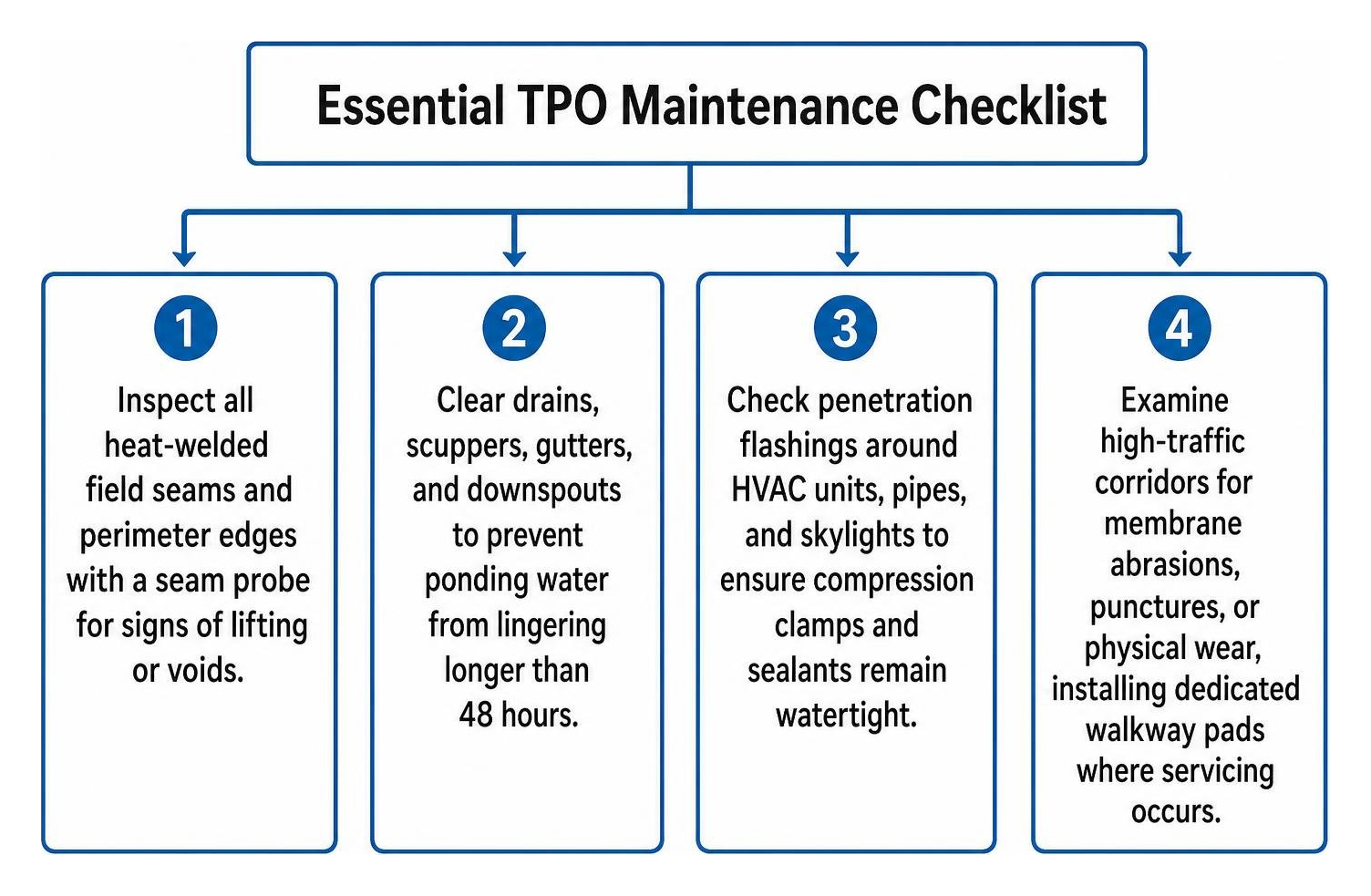
Essential TPO Maintenance Checklist:
- Inspect all heat-welded field seams and perimeter edges with a seam probe for signs of lifting or voids.
- Clear drains, scuppers, and downspouts to prevent ponding water from lingering longer than 48 hours.
- Check penetration flashings around HVAC units, pipes, and skylights to ensure compression clamps and sealants remain watertight.
- Examine high-traffic corridors for membrane abrasions, punctures, or physical wear, installing dedicated walkway pads where servicing occurs.
- Inspect metal edge coping, counterflashings, and termination bars for loose fasteners or failing sealants.
Frequently Asked Questions About TPO Roofing
What Warranties Should I Expect from TPO Roofing Contractors Near Me?
When investing in a TPO roof, you should receive a clear explanation of two distinct coverages:
- Manufacturer Warranty Coverage: Provided directly by the single-ply membrane manufacturer, covering material defects and, in certified commercial assemblies, comprehensive No Dollar Limit (NDL) system coverage that includes membrane, fasteners, and accessories.
- Workmanship Warranty: Provided directly by your roofing contractor, guaranteeing the quality of the installation, seam welding, flashing details, and perimeter terminations.
To keep all warranty coverage intact, building owners must maintain documentation of annual roof evaluations and ensure third-party contractors (like HVAC technicians) do not damage the membrane. Our team clearly explains all warranty coverage options prior to project commencement.
Can TPO Membrane Be Installed Over an Existing Flat Roof?
Yes, installing a TPO recover over an existing flat roof is often permissible, provided local building codes allow it (most municipal codes restrict buildings to a maximum of two roofing layers).
Before an overlay can proceed, a certified contractor must conduct thorough moisture scans and structural deck inspections. Any wet, trapped moisture or rotted substrate must be removed and replaced. If the existing roof assembly is heavily saturated, a full tear-off down to the structural deck is the only responsible, long-term solution.
How Does Extreme Weather and UV Exposure Affect TPO Seams?
TPO is engineered to withstand intense ultraviolet radiation and wide thermal fluctuations. Because the material expands in summer heat and contracts in sub-zero winter temperatures, poorly welded seams experience severe shear stress and will eventually pull apart.
Properly executed hot-air welds, however, create a homogeneous bond that flexes uniformly with the membrane. Routine inspections ensure that minor thermal movement along edge flashings and penetrations is managed before leaks occur.
Conclusion
Finding the right contractor for your flat or low-slope roof requires looking beyond basic proximity. The long-term protection of your building rests on heat-welded seam precision, meticulous substrate preparation, and proven single-ply membrane expertise.
Since 1914, South Bend Roofing Siding & Window Co. has delivered reliable, high-performance exterior solutions across Indiana and Michigan. With more than 110 years of continuous service, our certified single-ply installation teams understand how to design, install, and maintain durable TPO, PVC, and EPDM assemblies. We work around your operational schedule to minimize business interruptions while providing transparent evaluations, scheduled maintenance programs, and dedicated workmanship.
Whether you need targeted repairs to extend your roof's service life or a complete membrane replacement, we are here to provide clear guidance and dependable craftsmanship.
To evaluate your roof's condition or schedule a professional commercial roof assessment, call us directly at (574) 288-4764 for a free roof inspection and detailed written estimate.