Understanding the Core Types of Insurance Roof Inspection
When an insurance carrier requests an evaluation of your property, the scope and criteria depend entirely on the inspection's underlying purpose. Homeowners and commercial property managers frequently encounter two distinct categories: claims-driven inspections(reactive assessments triggered by severe weather or sudden events) and underwriting inspections(proactive risk evaluations conducted when binding a new policy or evaluating a renewal).
Understanding the differences between these evaluations prevents confusion, helps you prepare the necessary documentation, and ensures your property is fairly assessed.
| Inspection Type | Primary Purpose | Key Focus Areas | Typical Validity Period | Common Trigger |
|---|---|---|---|---|
| Claim Inspection | Quantify covered sudden damage for financial settlement | Hail strikes, wind creases, missing shingles, storm impact | Specific to the single loss event | Severe storm, windstorm, hail, falling tree limbs |
| Underwriting Inspection | Evaluate risk and overall insurability before issuing/renewing policy | Roof age, material condition, deferred maintenance, remaining useful life | 1 to 3 policy terms (carrier dependent) | New policy application, policy renewal, property transfer |
| 4-Point Inspection | Verify baseline condition of 4 primary home systems | Roof, electrical panels/wiring, plumbing supply/drains, HVAC systems | 1 Year (12 months for new carrier binding) | Homes older than 10 to 20 years applying for coverage |
| Wind Mitigation | Identify structural storm-hardening features for premium discounts | Roof-to-wall attachments, roof deck nailing, roof shape, water barriers | Up to 5 Years (unless structural changes occur) | Policyholder seeking windstorm premium credits |
Claims Inspections vs. Underwriting and Renewal Inspections
A claims inspection occurs after you notify your carrier of a specific, sudden loss event. The adjuster's mandate is to establish cause of loss, verify whether the damage falls within policy coverage, and calculate the cost of repair or replacement under your policy terms (such as Replacement Cost Value or Actual Cash Value).
In contrast, underwriting and policy renewal inspections assess the ongoing liability of insuring your structure. Insurance carriers evaluate whether an aging roof poses an unacceptable risk for future water intrusion. Underwriters examine roof age, general wear, granule loss, visible patching, and overall structural durability. If a roof exhibits significant curling or has exceeded its expected service life, an underwriter may issue a conditional requirement for replacement or issue a non-renewal notice. For homeowners navigating these evaluations, our team provides comprehensive residential roofing services to inspect decking, address localized wear, or replace aging materials before coverage issues arise.
4-Point and Wind Mitigation Assessments
In many coastal and storm-prone regions—and increasingly across Midwest markets for aging housing stock—insurers request specialized standardized reports.
A 4-point inspection examines four critical building systems:
- Roof Covering: Material type, estimated age, remaining useful life, and active leaks.
- Electrical System: Panel brand, wiring types (flagging hazards such as knob-and-tube or outdated panels), and GFCI protection.
- Plumbing System: Pipe materials (identifying polybutylene or corroded galvanized steel), water heater condition, and active drips.
- HVAC System: Heating and cooling operability, age, and permanent installation.
For detailed guidelines on system thresholds and inspection formats, review Kin's comprehensive 4-point inspection guide. Most carriers consider a 4-point inspection valid for one year.
A wind mitigation inspection, by comparison, is primarily beneficial to the property owner. It verifies construction features that reduce windstorm damage—such as hip roof geometry, reinforced roof deck attachments, clip/strap roof-to-wall ties, and secondary water resistance barriers. Documenting these features can qualify your property for mandatory state premium discounts, and the report remains valid for up to five years provided no structural alterations are made. To understand how these specialized evaluations intersect, review Manchester Insurance's breakdown on Wind Mitigation vs 4-Point vs Roof Inspection.
Roof Certifications and Remaining Useful Life Standards
When an insurer questions whether an older roof remains insurable, they may request a formal roof certification rather than a full home inspection. A roof certification is an objective statement prepared by a licensed roofing or building inspector detailing the roof's material, current physical condition, and estimated remaining useful life.
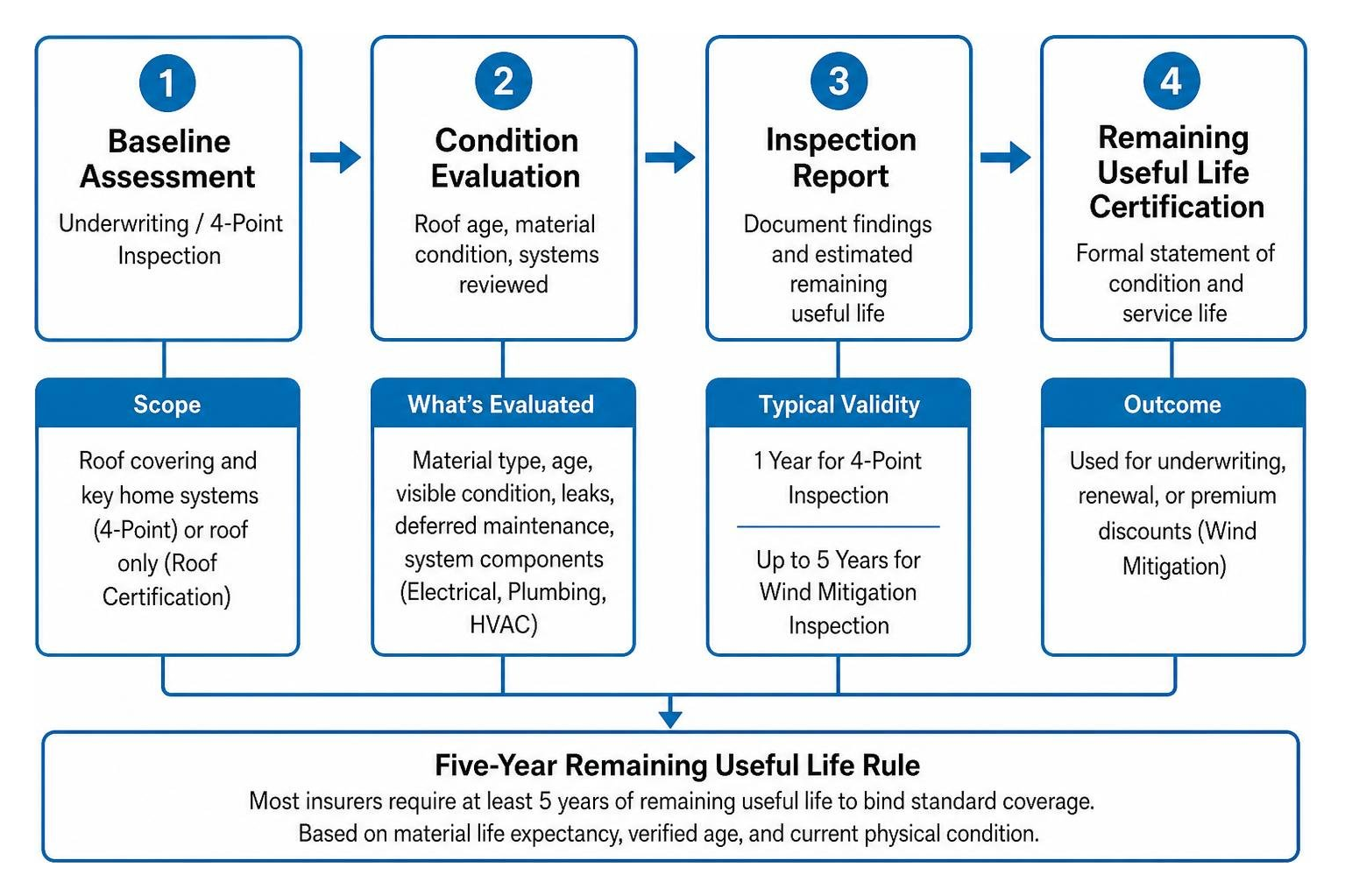
A standard rule of thumb across insurance underwriting is the five-year remaining useful life rule. Most major carriers will decline to bind standard coverage if an inspector determines the roof has fewer than five years of serviceable life remaining. The inspector calculates this by evaluating:
- The manufacturer baseline for the material (for example, standard asphalt architectural shingles average roughly 30 years, modified bitumen averages 20 years, and standing seam metal averages significantly longer).
- Actual chronological age verified through municipal building permits.
- Current physical degradation (granule loss, thermal cracking, biological growth, previous localized repairs).
Inspectors often document these findings using standardized templates, such as the widely referenced Citizens Roof Inspection Form (RCF-1) or standard third-party documents like the Inspection Xpress Sample Certification. For additional context on regional standards, see Kore Home Inspections' guide to Roof Inspection Certification.
How Adjusters Evaluate Storm and Hail Damage
When high winds, microbursts, or hail strike your property, insurance adjusters use structured, standardized methodologies to quantify damage. Understanding their technical criteria ensures you can review their field reports critically and verify that all affected slopes are evaluated. For commercial facilities managing large membrane surfaces, our commercial roofing services provide the specialized documentation required for flat PVC, TPO, and EPDM systems.
What to Expect During an Insurance Roof Inspection for Claims
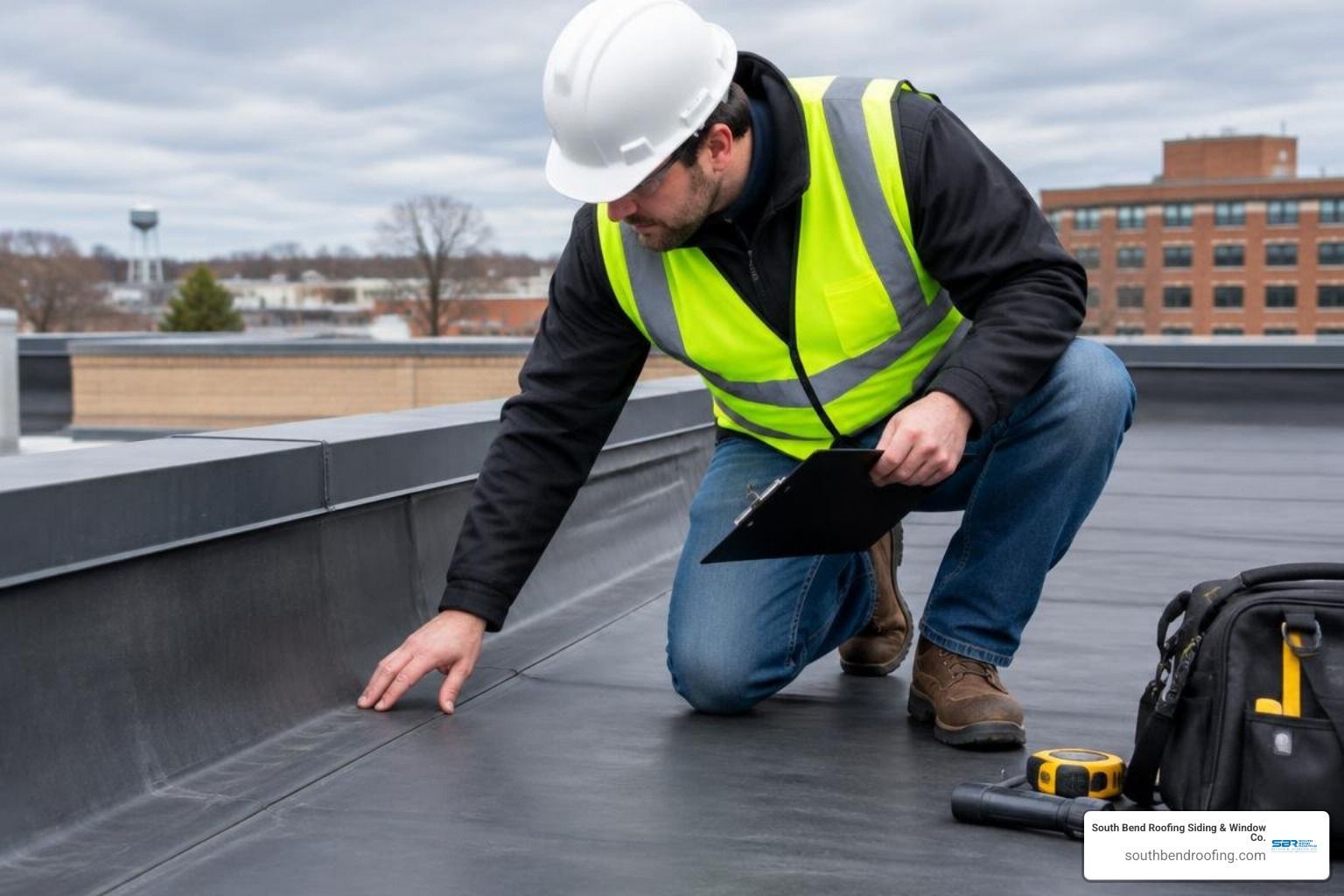
A field claims inspection typically takes between 30 and 60 minutes, depending on the square footage, pitch, and architectural complexity of your roof. During the walk-through, the adjuster:
- Inspects ground-level soft metals (downspouts, window trim, outdoor HVAC fins) for collateral hail dings, which corroborate storm direction and impact intensity.
- Ascends the roof to examine flashing, pipe boots, ridge vents, and chimney caps.
- Conducts a slope-by-slope evaluation to document wind-lifted or missing shingles and hail impacts.
- Checks interior ceilings and attic spaces for acute moisture intrusion resulting from storm-compromised decking.
If severe storm damage compromises the underlying decking across multiple slopes, a complete roof replacement and tear-offs project may be required to strip materials down to clean sheathing and bring the installation up to modern building code.
The 10x10 Test Square Method for Hail Strikes
To avoid subjective guesswork, insurance adjusters use the standardized 10x10 test square method across each distinct directional slope of the roof (North, South, East, West).
- Marking the Sample Area: The adjuster uses chalk to outline a 10-foot by 10-foot square (representing one roofing "square," or 100 square feet) on representative sections of each roof facet.
- Identifying Impacts: The adjuster counts the number of distinct hail strikes within that 100-square-foot boundary that have bruised or punctured the shingle substrate.
- Applying Carrier Hit Thresholds: Most property insurance carriers use an eight-hit threshold per test square. If a slope exhibits eight or more verifiable hail strikes within the test square, carrier guidelines generally classify that entire roof facet as damaged and warranting replacement rather than localized patching.
Functional Damage vs. Cosmetic Damage
One of the most frequent sources of dispute during an insurance claim inspection is the distinction between functional damage and cosmetic damage.
- Functional Damage: Alterations that diminish the water-shedding capability or long-term structural integrity of the roofing material. For asphalt shingles, this includes fractured fiberglass matting, granule displacement exposing the asphalt layer to ultraviolet degradation, or horizontal creases caused by wind uplift. Functional damage is covered under standard property casualty policies.
- Cosmetic Damage: Minor surface indentations or superficial blemishes that alter appearance without compromising water resistance or shortening the system's useful lifespan. Many modern residential and commercial policies contain specific cosmetic damage endorsement exclusions, particularly on metal roofing panels and architectural shingles. If hail leaves shallow indentations in a metal standing seam panel without rupturing seams or finish coats, the carrier may invoke this exclusion to deny payment.
Technology, Aerial Imaging, and Remote Inspections
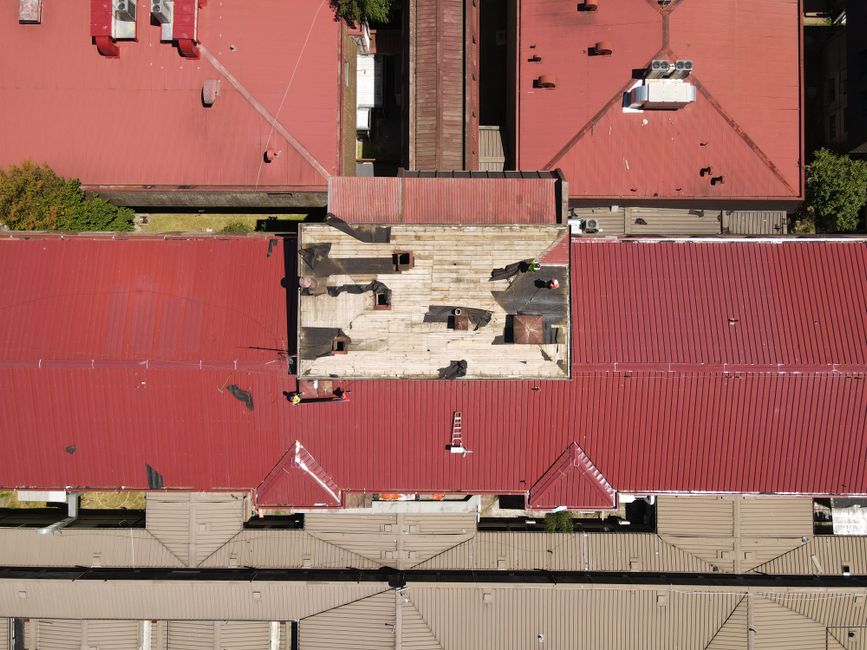
In recent years, the property casualty industry has shifted heavily toward remote assessment technologies. Underwriters and claims departments increasingly use high-resolution drone photography, fixed-wing aircraft flyovers, and satellite imaging to monitor roof conditions without dispatching a field inspector.
State regulatory bodies have outlined how these technologies may be applied. The Massachusetts Division of Insurance details consumer rights and carrier notice requirements in their guidance on Understanding How Insurance Companies Use Aerial Imaging to Assess Roof Condition. Underwriters use machine-learning algorithms to scan aerial images for telltale risk factors: visible tarping, pooled water, rusted valley metal, heavy moss or tree overgrowth, and missing shingle tabs.
Preparing for an Insurance Roof Inspection and Underwriting Review
If your carrier has notified you of an upcoming roof inspection—or if you are applying for new coverage—proactive preparation ensures accurate, unbiased findings:
- Clear Debris: Sweep off accumulated leaves, pine needles, and moss from valleys and roof edges. Heavy organic debris can obscure sound shingles and trigger automated underwriting flags.
- Compile Documentation: Gather building permits, manufacturer invoices, warranty transfers, and past maintenance receipts that prove roof age and verify professional installation. You can view examples of properly completed, fully permitted projects in our project gallery.
- Trim Overhanging Branches: Remove limbs within six to ten feet of the roof surface to prevent mechanical scuffing and eliminate shade that promotes moisture retention.
- Perform Ground-Level Photography: Take clear, timestamped photos of all elevations and slopes from ground level before the adjuster arrives.
Independent Roof Inspectors vs. Insurance Adjusters
It is vital to distinguish the roles of the professionals evaluating your roof:
- Staff or Independent Insurance Adjusters: Work directly for or contract with the insurance company. Their responsibility is to evaluate the claim against specific policy language, carrier hit thresholds, and liability limits.
- Third-Party Certified Roof Inspectors: Independent specialists hired directly by the property owner. They provide an objective engineering or condition report detailing all visible defects, structural anomalies, and accurate repair scopes without carrier-imposed limitations.
- Licensed Roofing Contractors: Practical builders who calculate real-world material, labor, code compliance, and tear-off costs required to restore your roof safely to manufacturer specifications.
Having a qualified roofing professional present during the adjuster's field inspection ensures both parties examine the same test squares, discuss structural framing requirements, and document flashing and decking conditions accurately.
Navigating Denials, Disagreements, and Next Steps

Receiving an unexpected claim denial, partial approval, or underwriting non-renewal notice can be stressful, but property owners have formal procedural options to challenge inaccurate assessments.
Common Reasons for Claim Denials and Policy Non-Renewals
- Wear, Tear, and Deterioration: The carrier attributes missing granules or leaks to natural aging, thermal expansion, or poor attic ventilation rather than storm-created functional openings.
- Pre-Existing Installation Defects: Adjusters cite improper nail placement, insufficient valley flashing, or lack of code-required ice and water barrier as the root cause of water damage.
- High Deductibles: Wind and hail deductibles are frequently structured as percentage-based deductibles rather than fixed dollar amounts. For example, a 2% wind/hail deductible on a home insured for $400,000 requires an $8,000 out-of-pocket expenditure before carrier coverage applies.
- Underwriting Non-Renewal Windows: Carriers issuing non-renewal notices based on aerial imaging must comply with statutory notice windows (typically 45 days prior to policy expiration, depending on state regulations).
Steps to Take When You Disagree with the Claim Decision
If an adjuster's written scope of work misses documented storm damage or improperly denies a valid claim:
- Request the Complete Adjuster's Field Report: Obtain the itemized estimate, photographic log, and written reasoning for any denied slopes or line items.
- Obtain Detailed Contractor Documentation: Have a certified roofing professional perform an independent inspection that includes chalked test square photos, close-ups of ruptured fiberglass mats, and documentation of local building code compliance requirements.
- File a Request for a Supplemental Claim: Submit your contractor's documented scope of work to the carrier's claims desk, requesting a supplemental estimate or a re-inspection with a senior adjuster.
- Invoke the Policy Appraisal Clause: If you and the carrier agree that damage occurred but dispute the financial cost of repair or replacement, most standard policies permit either party to invoke the formal Appraisal Process. Each party selects an independent appraiser, and the two appraisers select a neutral umpire to establish a legally binding settlement.
- Contact Your State Department of Insurance: If you believe a carrier has acted in bad faith, misapplied policy endorsements, or failed to adhere to statutory claim handling timelines, you can file a formal complaint with your state insurance commissioner.
Frequently Asked Questions About Insurance Roof Inspections
How long does an insurance roof inspection usually take?
A standard residential inspection takes approximately 30 to 60 minutes. Complex architectural layouts, multiple stories, steep pitches, or large commercial membrane systems can extend the inspection to several hours, especially when interior moisture mapping and attic crawlspace evaluations are included.
What is the minimum remaining useful life required to pass an underwriting roof inspection?
Most national property and casualty carriers require a minimum of five years of remaining useful life to bind new coverage or renew standard policies. If an inspection report indicates fewer than five years of serviceable life, the carrier may require roof replacement as a condition of continued coverage.
Can an insurer drop my coverage based solely on satellite or drone photos?
Yes, insurance carriers have the legal right to use aerial imagery to assess property risks and enforce underwriting guidelines. However, state insurance laws require carriers to provide formal written notice (typically 45 days in advance) stating the specific underwriting reasons for non-renewal. Property owners can contest these notices by providing contrary proof, such as recent roofing contracts, municipal permits, or a certified inspection report showing the roof is sound.
Conclusion
An insurance roof inspection plays a pivotal role in protecting your home's structural integrity and preserving your insurance coverage. Whether you are navigating a recent storm claim, responding to an underwriting review, or scheduling proactive maintenance, having clear, objective documentation is your strongest asset.
At South Bend Roofing, we bring more than 110 years of trusted local roofing experience—serving home and business owners across Indiana and Michigan since 1914. Our certified team provides honest, detailed assessments, helping you understand whether localized repairs can extend your roof's service life or if a full tear-off and replacement is necessary.
For professional guidance or to schedule your free roof inspection and estimate, contact our team today at (574) 288-4764.